Mathematical Model of Human Relationship Dynamics
Introduction to the experiment
After completing an intensive training program on mathematical modeling with MATLAB and Simulink, I decided on an unusual topic for my final project: instead of modeling a physical system, I explored whether aspects of interpersonal relationships could be described through coupled differential equations.
This project should be understood as an experiment in systems thinking rather than a contribution to academic psychology. The model developed is not based on empirical psychological data and should not be interpreted as a predictive model of real relationships or as a psychologically validated theory. Rather, my goal was to explore what kinds of complex behavior might emerge from relatively simple dynamic interactions.
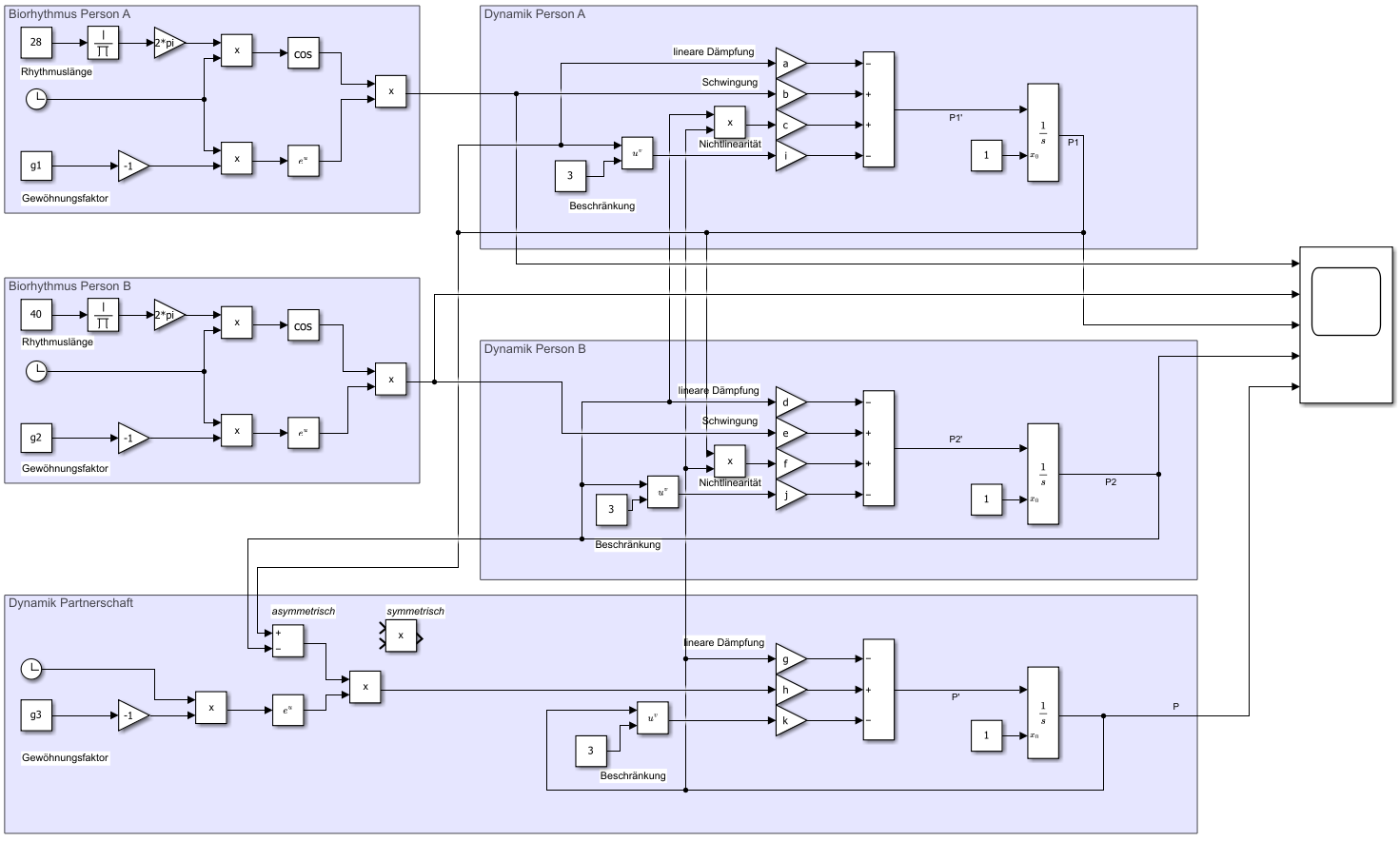
My model consists of three coupled differential equations representing two humans and the relationship itself as an emergent dynamic entity.
Design Guidelines
I think that the quality of a model improves when the modeling approach is designed to align with the nature of the object being modeled. Since the object in question is a psychological construct, I loosely drew inspiration from concepts found in depth psychology.
- The relationship as a third component: Apart from the two humans, I added the relationship itself as a third element on the top level of the model. This element is non-physical. Nevertheless, in the realm of depth psychology relationships could be viewed as having emergent properties and dynamics that cannot be reduced entirely to the individuals involved.
- Signal feedback: All three components are modeled with signal feedback. This matches the self-referencing and self-sufficient nature of psychological perspectives.
- Intuition and AI: The summands of the actual equations as well as the parameter values are developed using a mix of psychological intuition and support from AI. This corresponds to the mix of personal and collective influences in a truly psychological viewpoint.
I used these design guidelines in the early, creative stages of system modeling. Potential following stages can, of course, be based on more structured or scientific methods.
Model Details
The Simulink model contains one subsystem for each of the three main components. Each subsystem represents a differential equation with three inputs:
- Linear damping through signal feedback (representing internal emotional feedback)
- Non-linear influence through input from the two other components (representing empathy-like interactions)
- Cubic restriction (representing the natural limitation of emotions)
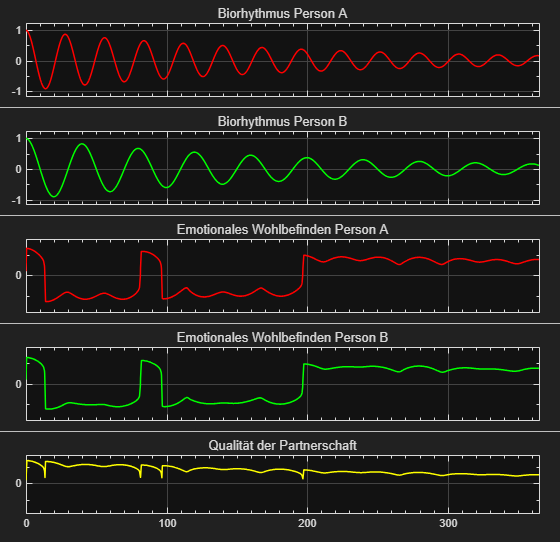
The two humans receive a forth input – their own energetic level. These are modeled as a simple damped cosine signal (similar like used in the controversial concept of bio rhythm).
For the non-linear influence on the relationship, I tried out both a symmetrical and an asymmetrical influence.
The period of the input signals of the energy of the partners I set to 28 days and 40 days, respectively. The other initial parameter values were selected experimentally with support from AI-assisted brainstorming and subsequently adjusted through simulation runs.
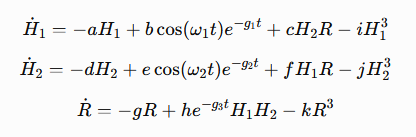
The Simulink model implements the following differential equations:
Simulation results
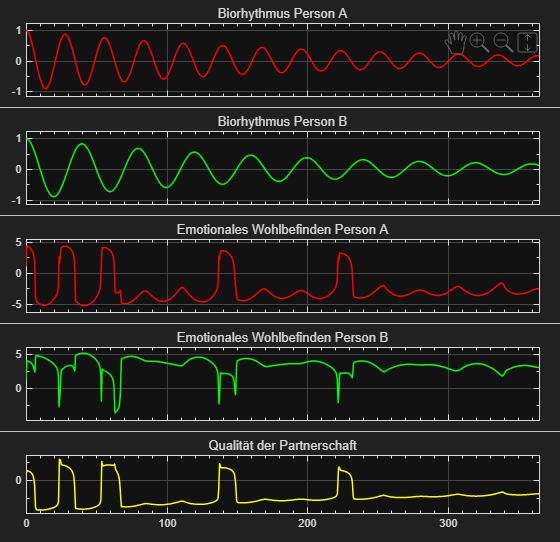
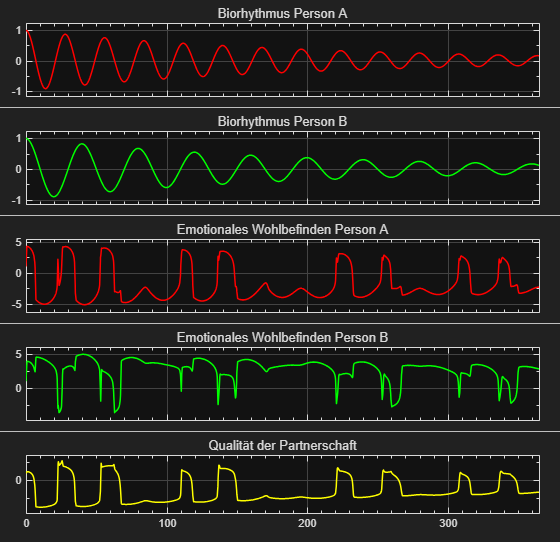
The simulations produced surprisingly rich dynamics. What I found particularly interesting was that complex and partly unpredictable behavior emerged despite the simplicity of the equations and the periodic nature of the inputs. The resulting dynamics showed characteristics often associated with real-world relationships: alternating phases of stability and turbulence, irregular peaks, and sensitivity to seemingly minor changes in conditions.
Future Work
There are several challenges to transform this approach from an exploratory experiment to a professional method, e.g.:
- Identify and extend a proper psychological theory as basis for improvement of the equations
- Add active psychological self-reflection and influence from society to the equations
- Improve the model by comparing the intuitively created concepts with collected data
- Explore whether meaningful parameter estimation approaches could be developed
- Investigate potential applications in education, coaching, or research settings